Our Story
About Us
Health for Remote Communities
Health Access Sumbawa (HAS) is a U.S. 501(c)(3) nonprofit dedicated to improving health in remote villages of Central Sumbawa, Indonesia. Our strength is managing the last mile—bringing practical, effective health solutions directly to rural families where they live. Our primary service area is the Cempi Bay region.
Origins
HAS began more than a decade ago. In 2014, I first visited a remote beach on Sumbawa Island. The hamlets along this coast had no running water, no toilets, no shops, and no access to health care. Many villagers were undernourished and suffered repeated malaria infections. One village—Sili—had relocated three times in 40 years trying to escape the disease.
Shortly after returning home to Maine, I was hospitalized with malaria myself. Friends and family rallied, and Health Access Sumbawa was born.
Malaria
Our first mission was eliminating malaria. We built a clinic with a simple laboratory and trained two staff as malaria microscopists. Volunteers installed thousands of insecticide‑treated bed nets. The program worked: malaria was eliminated within three years, and our area has remained malaria‑free for a decade.
Health Posts
HAS built a second clinic in Panubu hamlet, complete with staff housing. The site is surrounded by organic gardens and sits just a short walk from the beach and village center.
Beyond the Clinic
More than 60% of health outcomes are shaped outside clinic walls. That’s why roughly half our annual budget supports public health and food security programs—improving nutrition, hygiene, clean water access, and preventing infectious disease.
Organic Farms
Food security has been a priority since day one. Today HAS supports large community gardens in three villages, funding fencing, wells, water towers, seeds, and more. These communities were food deserts only a few years ago.
Workshops & Children’s Clubs
HAS runs after‑school programs for at‑risk children, including orphans, reaching more than 100 children each week.
What’s Next
Three years ago, the Sumbawa Health Department asked for our help eliminating malaria in remaining endemic areas of the Regency. HAS responded with thousands of LLIN bed nets and our experienced malaria team. Together, we are on track to eliminate malaria from the entire Regency by 2027.
Doctors’ Virtual Office (DVO): Telehealth & AI Tools
HAS recently launched a telemedicine initiative connecting city doctors with patients and nurses in remote villages. Our hybrid model blends the strengths of in‑person care with virtual consultations.
With Starlink high‑speed internet now installed at our clinic, remote nurses can use medical chatbots for clinical guidance and connect patients to physicians via telehealth.
Digital medicine is advancing rapidly, and universal broadband is finally reaching remote areas. HAS intends to ride this wave of innovation to expand healthcare equity and improve outcomes for the communities we serve.
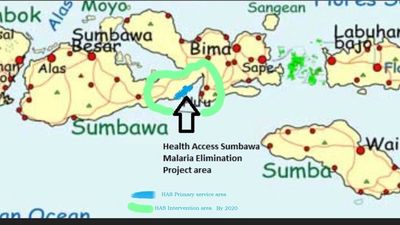
HAS service area map